Freud and the Politics of Psychoanalysis by José Brunner
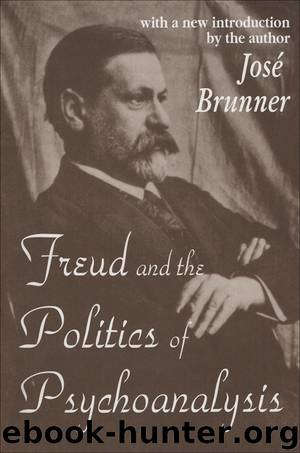
Author:José Brunner
Language: eng
Format: epub
Publisher: Routledge
Published: 2018-03-20T16:00:00+00:00
12 Psychiatry Goes to War
By the time of the Great War, Freud’s theory had become the property of a small but active therapeutic community and determined how its members treated their patients. In my view, the way in which this group related during the war to governmental and military authority on the one hand, and to their patients on the other hand, provides significant evidence to suggest that psychoanalytic discourse played an important role in discouraging therapeutic violence. It shows that even under circumstances in which military authorities legitimized medical brutality, the therapeutic approach developed by Freud led psychoanalytically trained and inspired doctors to treat their patients in a humane manner. Thus, in contrast with non-analytic army physicians, psychoanalysts who served in the Central Powers’ armies did not become ruthless when they treated ‘shell-shocked’ conscripts in the service of their states or nations.
As the governments of Austro-Hungary and Germany hurried to turn their citizens into soldiers in 1914, conscripts were inserted in military machineries which rearranged them on a scale and with an urgency previously unknown. In order to train soldiers for war and to increase their capacity to fight in battle, their minds and bodies were treated as objects. This imposition of military discipline on conscripts, together with the actual experience of war, caused traumatic disorders. Some conscripts became paralyzed, blind, mute or deaf, and others developed organically unexplainable trembling, twitching or cramps. Their consciousness, cognition or sensation became muddled, or they were overcome by severe anxieties, phobias and depressions. Soon such symptoms became epidemic and made a large number of soldiers unsuited for war because they were no longer able to participate in drill or battle. Such deviant behaviour brought them in conflict with the aims of their governments and armies.
Army doctors entered this conflict in an official role, in which they served their military superiors. The doctors’ task was to stop the production of symptoms and return neurotics to their social role as docile fighting men for which the state had them conscripted. When treating soldiers who had developed symptoms, army psychiatrists were guided by nationalist commitment rather than concern for their patients. Whatever theoretical approach they took, they defined their therapeutic task as administrative intervention to increase the docility of soldiers to the state and its military purposes.
In the early days of the war, the psychiatric establishment in Germany and Austro-Hungary was caught in a somatic model of nervous diseases attributed above all to the work of Hermann Oppenheim in the late 1880s.1 Hence the first soldiers who entered military hospitals with tremors, stupors or paralyses were diagnosed as suffering from an organic impairment of the nervous system – the famous ‘shell shock [Granatschock]’ – which was assumed to be caused by the explosion of shells, bombs and grenades. Since there was no medication or therapy for curing organic disorders or healing lesions of the nerves or the brain, shell-shocked soldiers were usually sent to rural areas to rest. On the other hand, as John Keegan
Download
This site does not store any files on its server. We only index and link to content provided by other sites. Please contact the content providers to delete copyright contents if any and email us, we'll remove relevant links or contents immediately.
Rewire Your Anxious Brain by Catherine M. Pittman(18708)
Talking to Strangers by Malcolm Gladwell(13438)
The Art of Thinking Clearly by Rolf Dobelli(10596)
Mindhunter: Inside the FBI's Elite Serial Crime Unit by John E. Douglas & Mark Olshaker(9418)
Becoming Supernatural by Dr. Joe Dispenza(8277)
Change Your Questions, Change Your Life by Marilee Adams(7846)
Nudge - Improving Decisions about Health, Wealth, and Happiness by Thaler Sunstein(7758)
The Road Less Traveled by M. Scott Peck(7657)
The Lost Art of Listening by Michael P. Nichols(7547)
Mastermind: How to Think Like Sherlock Holmes by Maria Konnikova(7427)
Enlightenment Now: The Case for Reason, Science, Humanism, and Progress by Steven Pinker(7353)
Win Bigly by Scott Adams(7253)
The Way of Zen by Alan W. Watts(6669)
Daring Greatly by Brene Brown(6556)
Big Magic: Creative Living Beyond Fear by Elizabeth Gilbert(5827)
Grit by Angela Duckworth(5669)
Ego Is the Enemy by Ryan Holiday(5521)
The Laws of Human Nature by Robert Greene(5320)
Men In Love by Nancy Friday(5292)
